Polyvagal Theory
Dr. Stephen Porges' revolutionary framework for understanding how your nervous system organizes your experience of safety, danger, and life threat.
What Is Polyvagal Theory?
Polyvagal Theory, developed by Dr. Stephen Porges in 1994, is a neurophysiological framework that fundamentally changed our understanding of the autonomic nervous system. Before Polyvagal Theory, the ANS was understood as a simple two-part system: sympathetic (fight/flight) and parasympathetic (rest/digest). Porges revealed a more nuanced picture — the vagus nerve actually has two distinct branches, each with different evolutionary origins and functions.
The word "polyvagal" literally means "many vagal" — referring to the multiple pathways of the vagus nerve. This theory explains why humans can shift between states of social engagement, defensive mobilization, and protective shutdown. It provides the scientific foundation for understanding why trauma responses look the way they do, why co-regulation is essential for healing, and why safety is not just a feeling but a biological state.
The Autonomic Ladder
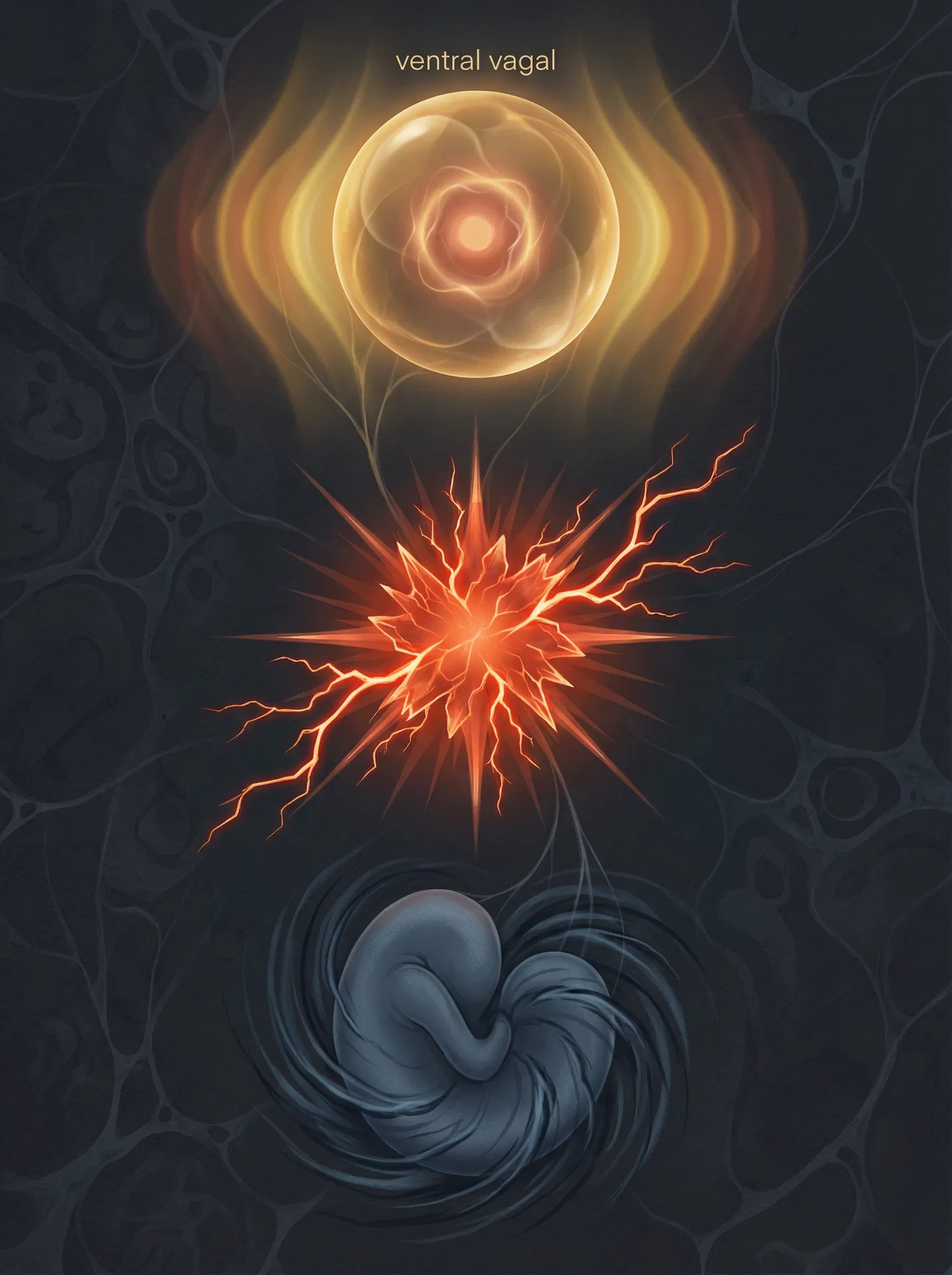
Polyvagal Theory describes three hierarchical states of the autonomic nervous system, organized like a ladder from most evolved (top) to most primitive (bottom).
Ventral Vagal: Safety & Social Engagement
The ventral vagal state is mediated by the newer, myelinated branch of the vagus nerve — unique to mammals. This is the state of safety, connection, and social engagement. When you are in ventral vagal, your nervous system has determined that the environment is safe enough to engage socially, think creatively, and be present.
What It Feels Like
- Calm, grounded, present
- Open and curious
- Connected to others
- Able to think clearly and creatively
- Flexible and adaptive
- Playful, able to laugh
Physiological Markers
- Relaxed facial muscles
- Prosodic (melodic) voice
- Steady heart rate with good HRV
- Easy, rhythmic breathing
- Healthy digestion
- Strong immune function
Sympathetic Activation: Mobilization
When the nervous system detects danger (real or perceived), it drops down the ladder into sympathetic activation — the fight-or-flight response. This is your body's mobilization system. It evolved to help you survive physical threats by preparing your body for action. In the modern world, this same system activates for psychological threats: a critical email, a conflict with a colleague, financial uncertainty, or even scrolling through stressful news.
What It Feels Like
- Anxious, restless, on edge
- Irritable, easily triggered
- Racing thoughts
- Sense of urgency or impending doom
- Difficulty sitting still
- Hypervigilance — scanning for threats
Physiological Markers
- Elevated heart rate
- Shallow, rapid breathing
- Muscle tension (jaw, neck, shoulders)
- Digestive disruption
- Increased cortisol and adrenaline
- Reduced access to prefrontal cortex
Dorsal Vagal: Immobilization & Shutdown
The dorsal vagal state is mediated by the older, unmyelinated branch of the vagus nerve — shared with reptiles. This is the most primitive survival response. When the nervous system determines that the threat is overwhelming and cannot be escaped through fight or flight, it drops to the bottom of the ladder into shutdown. This is the freeze, collapse, or dissociation response. It evolved as a last-resort survival mechanism — playing dead to survive a predator.
What It Feels Like
- Numb, disconnected, foggy
- Hopeless, helpless
- Exhausted without physical cause
- Dissociated — feeling unreal
- Withdrawn, wanting to hide
- Unable to think or make decisions
Physiological Markers
- Lowered heart rate and blood pressure
- Flat, monotone voice
- Slumped posture
- Reduced pain sensitivity
- Digestive shutdown
- Lowered metabolic activity
Detection Without Awareness
One of Polyvagal Theory's most important contributions is the concept of neuroception.
Neuroception is the term Dr. Porges coined to describe the subconscious process by which your nervous system continuously evaluates risk and safety in your environment. Unlike perception (which is conscious), neuroception happens beneath your awareness. Your nervous system is constantly scanning three domains for cues of safety or danger:
The External Environment
Is the physical space safe? Is it too loud, too bright, too chaotic? Are there unfamiliar people? Is there an exit? Your nervous system processes these environmental cues before your conscious mind even registers them.
Other People
Are the people around you safe? Your nervous system reads facial expressions, vocal tone, body posture, and eye contact to determine whether another person's nervous system is regulated or dysregulated. This is why a calm presence can settle you, and an agitated person can trigger you — even without words being spoken.
Your Internal State
What is happening inside your body? Is your heart racing? Is your stomach tight? Are your muscles tense? Internal sensations (interoception) feed directly into neuroception. If your body is already in a state of tension, your nervous system is more likely to interpret neutral stimuli as threatening.
Why the Order Matters
The three autonomic states are not random — they follow a strict evolutionary hierarchy. Your nervous system always attempts to use the most evolved response first (ventral vagal / social engagement). Only when that fails does it escalate to sympathetic mobilization (fight/flight). And only when mobilization fails does it resort to dorsal vagal shutdown (freeze/collapse).
This hierarchy also works in reverse during healing. You cannot jump from dorsal vagal shutdown directly to ventral vagal safety. You must move through sympathetic activation first. This is why people in recovery from deep shutdown often experience a period of increased anxiety or agitation — they are moving up the ladder, and that is actually progress. Understanding this hierarchy prevents you from misinterpreting your healing process.
Module 2 Key Takeaways
Polyvagal Theory reveals three autonomic states: ventral vagal (safety), sympathetic (mobilization), and dorsal vagal (shutdown).
The vagus nerve has two distinct branches — the newer ventral branch (social engagement) and the older dorsal branch (immobilization).
Neuroception is the subconscious process by which your nervous system evaluates safety and danger — it can be faulty.
The states follow a strict hierarchy: safety → fight/flight → shutdown. Healing reverses this order.
Many high performers operate in sympathetic activation masked by ventral vagal social skills — this is unsustainable.
Understanding your autonomic state is the first step to changing it.
Go Deeper
This module is part of the knowledge foundation. When you are ready to move from understanding to guided implementation, The High Level Life Method provides the structure, support, and expertise to transform what you have learned into lasting change.
Learn more at The High Level Life